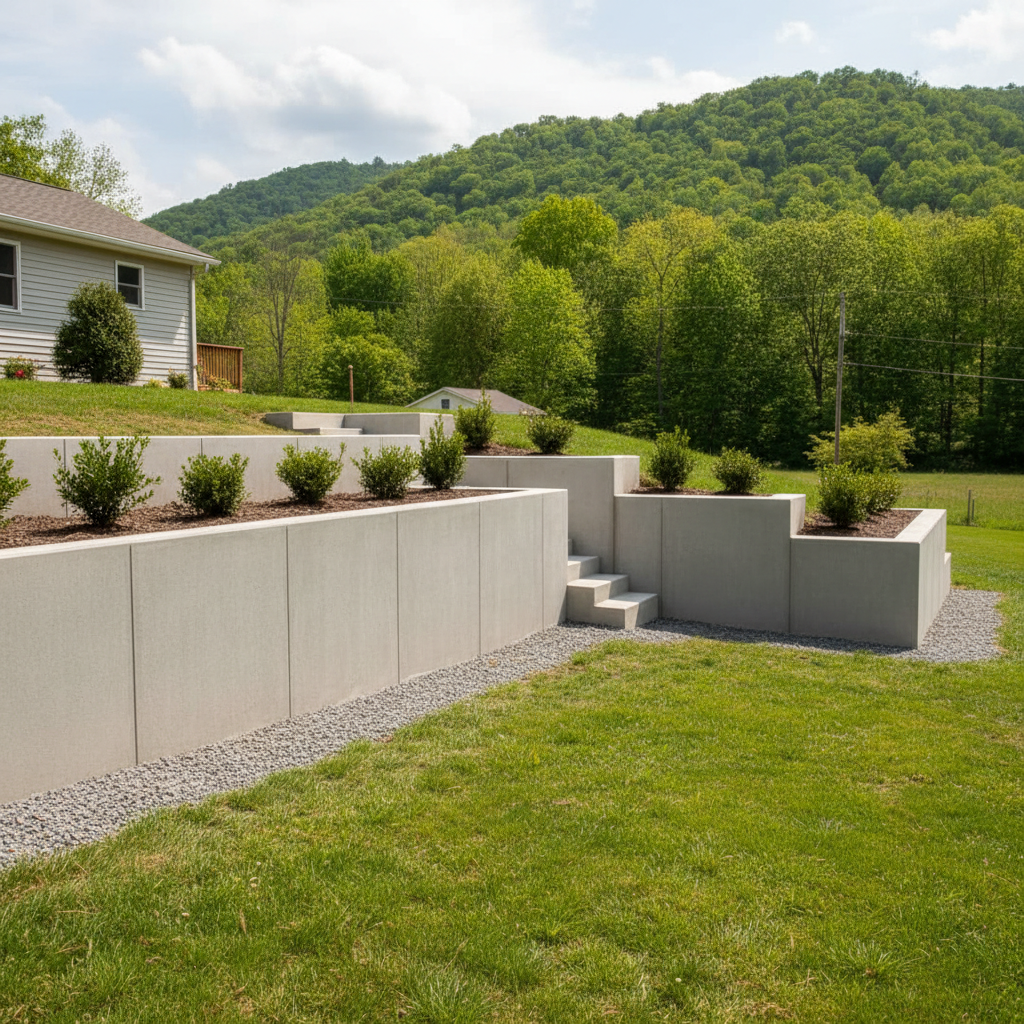
Thinking about putting in a concrete retaining wall? Good move. They're strong, they last, and honestly, they can totally change a sloped yard or fix some pretty serious drainage issues. But let's be real, the first thing on most folks' minds is, "How much is this going to cost me?"
You'll hear a lot of general numbers floating around, but I'm going to give you the straight scoop for Cedar Grove, WV, based on what I've seen over the years. It's not a one-size-fits-all answer, no, but I can give you some solid ranges and tell you what makes those numbers jump around.
What Makes a Retaining Wall Cost More (or Less)?
A concrete retaining wall isn't just a slab of concrete. There's a lot that goes into it, and each factor plays a role in the final bill. Here's what we typically look at:
- Size and Height: This is probably the biggest factor, wouldn't you say? A 3-foot tall wall for a small garden bed is a whole different ballgame than a 10-foot tall structural wall holding back a hillside. The taller and longer it is, the more materials, labor, and often, engineering it'll need.
- Wall Type: Are we talking about a poured-in-place concrete wall, or segmental block walls? Poured concrete is usually stronger and can be more complex, often needing rebar and specific forms. Segmental blocks are often quicker to install but might not be right for very tall or heavily loaded walls. For this guide, I'm focusing on poured concrete, which is what Guardian Concrete specializes in.
- Site Prep and Digging: This is huge, especially around here. If your yard is already fairly level, great. But if we're digging into a steep hillside, or if there are a lot of roots, rocks, or old debris to remove, that adds significant time and cost. I've seen plenty of properties in the Kanawha City area, for example, where the ground is just packed clay and rock, making excavation a real chore.
- Drainage Needs: A retaining wall without proper drainage is a ticking time bomb. Water pressure behind the wall can cause it to crack, bow, or even fail. We always include a drainage system – typically a perforated pipe (French drain) behind the wall, backfilled with gravel, and weep holes. The complexity of this system depends on how much water we expect to manage.
- Footings and Reinforcement: A good wall needs a good foundation. This means a proper concrete footing below the frost line (which is about 30 inches deep in our area) and often steel rebar reinforcement throughout the wall itself. The deeper and wider the footing, and the more rebar needed, the higher the material and labor costs.
- Accessibility: Can we get our equipment right up to the work area, or do we have to hand-carry materials and use smaller tools? Tight spaces, fences, or fragile landscaping can slow things down and increase labor.
- Finishing Options: Do you want a plain concrete finish, or something decorative? Stamping, staining, or adding a texture will add to the cost, but it can also make the wall a real feature.
Typical Costs for Concrete Retaining Walls in Cedar Grove
Alright, let's get to some numbers. Keep in mind these are averages, and your specific project could be higher or lower depending on those factors I just mentioned. These prices generally include excavation, forming, rebar, concrete, backfill, and a basic drainage system.
- Small, Non-Structural Walls (2-4 feet tall): For something like a garden bed or a small terrace, you're usually looking at around $40 to $70 per linear foot. These are simpler, don't always need heavy machinery, and are often less complex in terms of engineering.
- Medium-Sized Walls (4-6 feet tall): This is where most residential retaining walls fall. Expect to pay in the range of $70 to $120 per linear foot. These walls definitely need proper footings, rebar, and good drainage. Excavation can be a bigger factor here.
- Large, Structural Walls (6-10+ feet tall): For serious earth retention, like holding back a large bank or creating a usable yard out of a steep slope, costs can jump to $120 to $250+ per linear foot. These projects often require engineering plans, heavier equipment, and more specialized labor. The amount of concrete and steel needed goes up significantly.
So, for a typical 50-foot long, 5-foot tall retaining wall, you could be looking at anywhere from $3,500 to $6,000. If it's a big, complex job, that 50-foot wall might easily hit $10,000 or more.
What's in a Guardian Concrete Quote?
When you get a quote from us, we break it down so you know exactly what you're paying for. You won't get any surprises. Our quotes typically include:
- Site Visit & Consultation: We come out, look at your property, and talk about what you need. We'll take measurements too.
- Detailed Scope of Work: A clear description of what we'll be building, including dimensions and materials.
- Excavation: Digging out the area for the footing and behind the wall.
- Footing Construction: Forming and pouring the concrete foundation.
- Wall Construction: Forming, rebar installation, and pouring the concrete for the wall itself.
- Drainage System: Installation of a perforated pipe, gravel backfill, and weep holes.
- Backfilling: Filling in behind the wall once it's cured.
- Material Costs: All concrete, rebar, forms, gravel, and drainage pipe.
- Labor Costs: Our crew's time on the job.
- Permit Assistance (if needed): We can help you navigate the local permit process, which is often required for walls over 4 feet tall.
- Cleanup: We don't leave a mess behind.
How to Save Money (and Headaches)
Nobody wants to get ripped off, especially on a big project like this. Here's my advice:
- Get Multiple Quotes: Don't just go with the first guy. Get at least three detailed quotes from reputable contractors. Then, compare them line by line.
- Check References and Reviews: See what other folks in Cedar Grove are saying about them. A good contractor will have plenty of happy customers.
- Ask for a Detailed Contract: Make sure everything is in writing: scope of work, materials, timeline, payment schedule, and warranty. If it's not on paper, it doesn't exist.
- Don't Automatically Go for the Lowest Bid: The cheapest quote often means corners are being cut. A wall that fails in a few years will cost you way more in the long run. Look for value, not just the lowest price.
- Understand the Drainage Plan: This is critical. Ask how they plan to manage water behind the wall. If they don't have a clear answer, that's a red flag.
- Be Clear About Your Expectations: Communicate what you want upfront. Changes mid-project can get expensive.
A concrete retaining wall is a big investment, but it's one that can add significant value and stability to your property. Do your homework, ask the right questions, and you'll end up with a wall that lasts for decades.