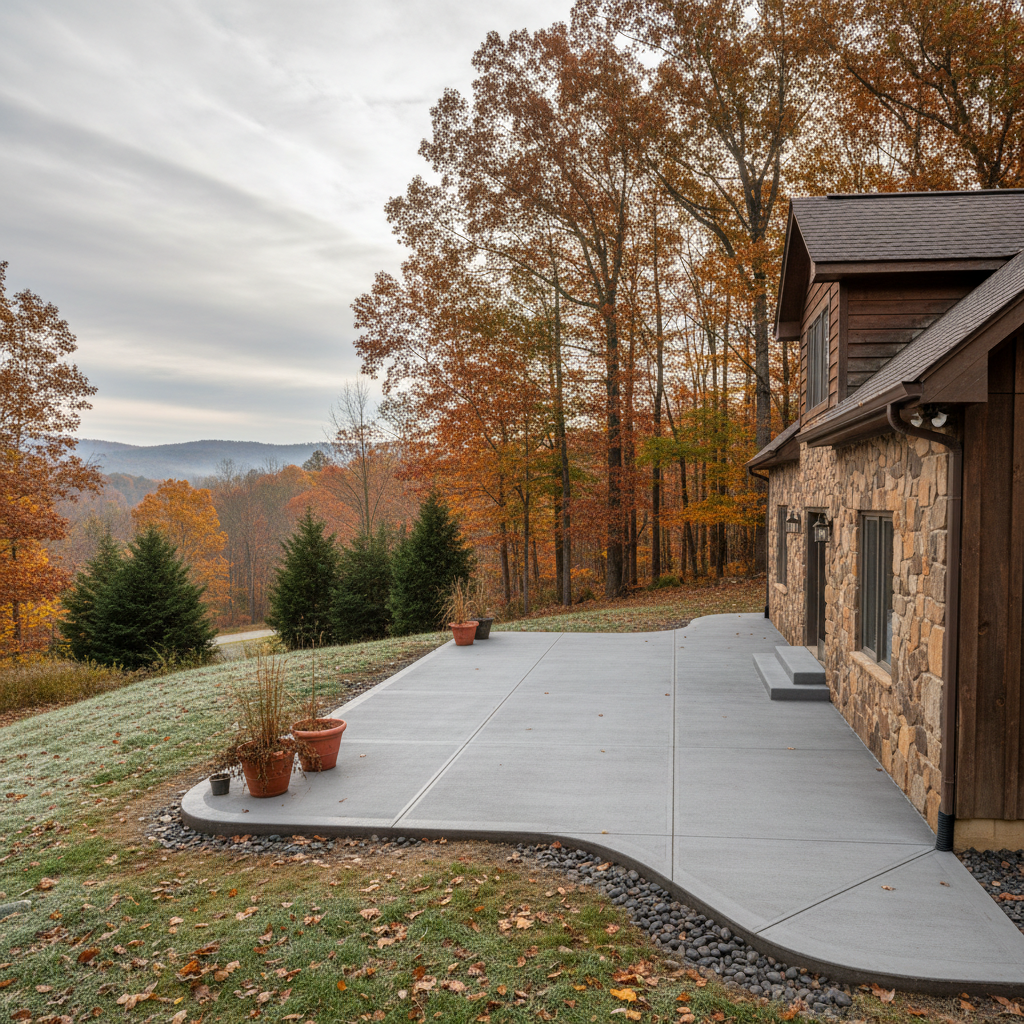
Mother Nature does not care much about your home improvement timeline, and here in the Kanawha Valley, the weather likes to keep us guessing. If you are planning a new driveway or patio, you have to work with our local climate instead of fighting it. Guardian Concrete sees people make the mistake of treating concrete like it is indestructible year-round, but weather plays a massive role in how concrete cures and holds up over time.
Understanding the Local Climate Challenge
Here in Cedar Grove, WV, we deal with everything from sweltering, humid summer stretches to freezing winter nights. That drastic swing between seasons triggers constant freeze-thaw cycles. When water gets trapped inside tiny pores in unsealed concrete and freezes, the water expands. That is how concrete cracks form.
Our soil conditions down by the river and up on the surrounding hillsides also shift with heavy seasonal rains. If a sub-base is not properly compacted to handle that moving ground, your fresh concrete slab will not last long, no matter how thick the concrete slab is.
Timing Your Concrete Installation Right
Timing is very important when you are pouring concrete. You cannot just pick a random Tuesday for Concrete Installation.
- Spring brings moderate temperatures, but it also brings heavy rain showers that can ruin a fresh concrete surface before the concrete sets.
- Summer offers long daylight hours, but extreme heat causes the water in the concrete mix to evaporate too fast, leading to shrinkage cracks in the concrete.
- Fall is usually the sweet spot with stable temperatures and lower humidity for Concrete Installation.
- Winter brings freezing temperatures that stop hydration dead in its tracks unless you are using specialized blankets and heating additives during Concrete Installation.
Aiming for late spring or early autumn usually gives you the most reliable conditions for a strong, long-lasting concrete cure in Cedar Grove, WV.
Protecting Your Investment Year-Round
Once your project is in the ground, keeping your concrete maintained prevents costly headaches down the road. Do not skip the sealer for your concrete. Putting down a quality penetrating concrete sealer every 2 to 3 years blocks out moisture and keeps road salt or de-icers from eating away at the concrete surface during winter storms.
Keep heavy organic debris like wet autumn leaves cleared off your concrete flatwork, too. They trap moisture against the concrete and can stain or degrade the concrete finish over time. A quick rinse with a garden hose goes a long way. Take care of your concrete, and the concrete will last for 15 to 20 years or more.